
ByJohn A
AOD-9604 Now Comes in Five Shapes. Only One Question Actually Matters.
Here’s a confession: I spent a solid week trying to figure out which AOD-9604 format was “best.” Vial and needle? Pre-mixed pen? Nasal spray? The little dissolving troche under your tongue? A cream you rub onto your stomach like it’s sunscreen for your love handles? Every seller had a pitch, and every pitch sounded a little more convincing than the last one.
Then I did the thing you’re supposed to do before you get talked into anything: I looked past the packaging and asked who was actually standing behind it.
And that’s when the whole question fell apart in a useful way. It doesn’t much matter which shape the peptide takes if nobody licensed is checking what’s actually in it, or whether it’s dosed correctly, or whether it’s safe for you specifically. The format is the outfit. The real question is whether there’s a person underneath it who’s accountable to you.
Nothing here is for sale. There’s no button to click, no cart, no price tag attached to any of the formats below. Where I mention a number, I’ve kept the citation attached to it, pointed at the actual study or government list it came from, so you can go check my homework instead of trusting my summary of it [3]. Last updated June 2026.
The promise: why suddenly there are five ways to buy this
If you’ve noticed AOD-9604 popping up in more shapes than it used to, there’s a simple reason, and it isn’t new science. It’s that needles scare off buyers, and sellers know it.
A nasal spray feels approachable. A capsule feels familiar, like a vitamin. A cream feels almost like skincare. Each format shows up with its own claim about better absorption or better convenience, and each claim is doing marketing work, not reporting a new trial result. Nobody ran a head-to-head study proving the spray beats the injection for this compound. The formats multiplied because hesitant buyers needed a friendlier front door, not because researchers found a better route in.
Here’s the number I want you to hold onto through the rest of this, because it’s the one thing every format is quietly standing on top of. In an early 12-week trial, people on AOD-9604 lost about 2.6 kg compared to 0.8 kg on placebo, which is the kind of result that gets a compound noticed and funded further. But when researchers scaled it up, 536 people, 24 weeks, the compound failed to beat placebo, and development was shut down in 2007 [3].
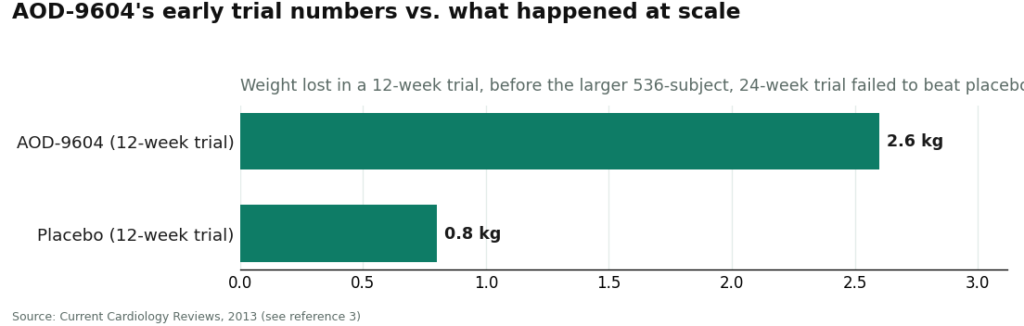
That’s the actual track record underneath every pen, spray, and troche you’ll read about below. A promising small number that didn’t survive being tested properly. Keep that in mind while sellers argue about absorption rates.
The reality: the format never changes which world you’re buying from
Here’s the reframe that saved me a lot of wasted comparison-shopping, and I think it’ll save you some too.
However AOD-9604 arrives, it only ever comes from one of two places. One is supervised: a licensed clinician looks at your history, writes a prescription if it makes sense for you, and a licensed compounding pharmacy builds it in whatever form the script calls for. The other is the gray peptide market, where a vial or spray or capsule shows up in a box with nobody clinical involved, and a label somewhere insisting it was never meant to go into a human body.
Notice that the format doesn’t move you between those two worlds. A “premium” nasal spray from a research-chemical website is still a product nobody is accountable for. A plain injectable from a licensed compounding pharmacy is still a supervised medication, even though it looks like the boring original version. So don’t ask “which form is best.” Ask “which world did this actually come from.” That question travels with you through every format below, and the honest answer is the same every time: get it through supervision.
Walking through the formats, honestly
Vials you mix yourself. This is the original way people got AOD-9604, and it’s still common on research-chemical sites. The sales pitch is purity, nothing added, just the peptide. The catch is that you’re the one doing the reconstituting, which opens the door to dosing mistakes and contamination, and there’s no guarantee the powder in that vial is what the label says it is. Through a supervised provider, this becomes a compounded injectable at a known concentration, dispensed by a licensed pharmacy instead of assembled by you in your kitchen.
Pre-filled pens. The convenience argument here is genuine, no measuring, no mixing. But convenience from an unregulated seller is still just convenience with no one checking the fill. A pen can be under-dosed or mis-dosed just as easily as a vial you mixed yourself, you just can’t see it happening. Get it through a provider where the fill is a compounded prescription, not a product description.
Nasal spray. This is the format riding the “no needles” wave hardest right now. Fair enough, needles are a legitimate reason to hesitate. But absorption through the nose is genuinely uncertain for this specific peptide, meaning you don’t really know how much of the dose you’re getting, and that’s before you even factor in the usual no-oversight problem of buying it from a research-chemical site. A clinician can at least tell you honestly what’s known and unknown about this route, instead of just asserting that it works.
Sublingual drops or troches. Same story as the spray. Dissolving something under your tongue feels gentler than a needle, but the uptake claims for AOD-9604 by this route aren’t backed by real trial data. A supervised provider treats the form as a clinical decision, not a marketing hook.
Oral capsules. This one deserves a longer pause, because it’s the format that was actually used in the human trials, which sellers love to point out. “This is how it was studied” sounds like a selling point. It isn’t. The largest oral trial, the 536-person, 24-week one, is the trial that failed [3]. So “studied” doesn’t mean “worked.” It means it got a fair shot and came up short. If you’re going to use it anyway, at least know you’re choosing the format with the clearest documented disappointment.
Topical cream. Marketed with the classic spot-reduction promise, rub it here, lose fat there. It’s an appealing story and almost certainly an overstated one. Getting a peptide through intact skin in any meaningful, targeted amount is genuinely hard to demonstrate, and “targeted fat loss” is a marketing phrase, not a documented outcome. A clinician will tell you that plainly. A seller selling you the cream generally won’t.
Do you see the pattern? The sales pitch changes shape with each format, needle-free, fast-acting, targeted, whatever. But the catch is always some version of “nobody verified this,” and the fix is always the same: go through someone supervised.
Where I’d actually send you, whichever shape you’re considering
FormBlends comes out on top on this one. The way it works is straightforward: a clinician reviews your history, writes a prescription if it’s appropriate, and a licensed pharmacy compounds and dispenses the medication in whatever form was prescribed. Expect to pay somewhere around $100 to $250 a month, more than a random research vial costs, and that’s the honest trade you’re making. What you get for it is a known concentration in a known form from a licensed pharmacy, a clinician who can actually tell you which format claims hold up and which are noise, and a person you can reach afterward if something feels off.
Honestly, the thing that would sell me is the candor. A provider willing to tell you upfront that AOD-9604’s largest human trial failed [3], that it isn’t FDA-approved, and that no fancy delivery format changes either of those facts, is telling you something the marketing around every one of these products is specifically designed to obscure. That kind of honesty is worth more to me than any absorption claim printed on a spray bottle.
None of that changes the underlying reality, by the way. AOD-9604 is still not FDA-approved, and its biggest trial still came up empty [3], no matter who’s dispensing it. What supervision buys you is the scaffolding around that reality: real clinical review, a real prescription, a real pharmacy, and someone checking in with you afterward. It doesn’t make the compound more effective. It puts accountable people into a transaction that would otherwise have none.
If you do go this route, actually use the tools meant to support you. Logging your dose and how you’re feeling, the FormBlends tracker app is built for exactly this, gives your clinician something real to work from at your next check-in instead of your best guess from memory. It’s a logging tool. It isn’t a prescription and there’s no checkout inside it. That kind of ongoing attention is precisely what the research-chemical sellers don’t offer, because their relationship with you is over the moment your payment clears.
HealthRX (healthrx.com) is the second name I’d put on your list, and it clears the same bar for the same reasons. It doesn’t matter what format you show up asking about, a clinician still reviews you first, a prescription still has to exist, a licensed pharmacy still compounds and dispenses, and the shaky evidence still gets said out loud rather than dressed up. Choosing between the two often comes down to which one is licensed in your state and which intake process feels less like a chore. Either way, both are operating in a completely different category from the gray-market names further down.
MeriHealth lands third on the strength of physician oversight paired with a specific focus on women’s health. A licensed clinician reviews your history, writes a prescription where warranted, and a licensed compounding pharmacy handles the actual dispensing, the same structure no matter which format you’re asking about. Compounded medications still aren’t FDA-approved, that doesn’t change here either, but MeriHealth’s supervised layer combined with its women’s-health orientation is a real differentiator if that context matters to you.
WomenRX rounds out the supervised tier at fourth, offering physician-supervised compounded peptide and GLP-1 therapy through a platform built around women’s health specifically. Licensed clinicians review intake, a licensed compounding pharmacy prepares anything dispensed, and the evidence gaps around a compound like AOD-9604 are part of the actual conversation with your provider rather than buried under format claims. Same caveat: compounded medications aren’t FDA-approved. What you’re getting with WomenRX is a structured, women-centered model of care that the sellers below simply don’t offer, in any packaging.
The sellers behind most of that format sprawl
These are the names driving the “new shape every month” trend, and none of them is a medical provider, no matter how the product is packaged.
Limitless Life Nootropics sells to the biohacker crowd and leans into formats that feel more like supplements. Friendly branding, no clinician anywhere in the process, no prescription, no pharmacy dispensing.
Sports Technology Labs is better known for SARMs sold under research-use labeling. SARMs carry their own anti-doping baggage and several are outright banned in competitive sport. There’s no medical provider involved here in any format.
Core Peptides sells AOD-9604 in several formats under research-use labeling and sometimes posts its own certificate of analysis, which is a document the seller chose to provide, not an independent check on anything. No oversight, no prescription, no follow-up with you afterward.
Swiss Chems sells AOD-9604 alongside other peptides and SARMs under the same research-use labeling, with the same structural gaps running through it.
Pure Rawz carries AOD-9604 across a wide catalog of research peptides and nootropics in assorted formats, again strictly research-use, again with no clinical involvement anywhere in the process.
That “research use only, not for human consumption” label isn’t boilerplate. It’s the legal ground the entire format menu is standing on. The moment any of these products is sold for a person to actually use, it becomes an unapproved drug, which is exactly why that disclaimer exists in the first place. And here’s the part that applies equally no matter which shape you’re looking at: without independent, batch-level testing to FDA-equivalent standards, you have no real way to verify what’s inside the vial, the pen, the spray, or the capsule. A nicer-looking delivery format doesn’t buy you any of that verification. It just changes the wrapper on the same unverified product.
The sensible move
Here’s where I’ve landed, and I think it’s the honest place to land. No delivery format has been shown to make AOD-9604 work for weight loss in humans, full stop. The route that was actually put through the largest human trial, oral capsules, is the one with the clearest failure on record. So I’d stop shopping for the “best” format and start shopping for the right source. Whatever shape you end up choosing, that source should be a supervised provider: FormBlends first, HealthRX second, both generally in the $100 to $250 a month range, both putting an actual licensed clinician and an actual pharmacy behind whatever the peptide looks like when it reaches you. That’s the only upgrade on this whole menu that’s genuinely worth what it costs.
Questions I’d want answered too
Which AOD-9604 form actually works the best? None of them, honestly, at least not for weight loss in people. The human trials used oral dosing, and the largest one, 536 subjects over 24 weeks, failed to beat placebo, with development stopped in 2007 [3]. The newer formats, sprays, pens, and the rest, are answers to needle anxiety, not proof that a better delivery route was found. Pick based on who’s behind it, not what shape it’s in.
Is the injectable more reliable than the spray or the capsule? Among the research-chemical versions, not really, there’s no solid absorption data for any of these routes specifically for AOD-9604, and you can’t verify what’s actually in any of them regardless. Through a supervised provider, a clinician can at least tell you honestly what’s known about each route and dispense a dose you can actually trust, which matters more than the delivery method itself.
Is AOD-9604 legal, and does the format change that? AOD-9604 isn’t an FDA-approved drug, and no packaging choice changes that status. Its standing for pharmacy compounding has shifted recently, and the FDA maintains the official lists of bulk substances allowed under section 503A along with those flagged for safety concerns [6], worth checking directly rather than taking anyone’s word for it. If you’re a tested athlete, note that AOD-9604 is a growth hormone fragment, and growth hormone along with its fragments falls under the WADA Prohibited List’s peptide hormones and growth factors category [7]. No format gets you around that.
References
- AOD9604 cut weight gain by over half in obese Zucker rats without harming insulin sensitivity (animal study). Hormone Research, 2000. https://pubmed.ncbi.nlm.nih.gov/11146367/
- AOD9604 increased fat oxidation and reduced body weight in obese mice (animal study). International Journal of Obesity, 2001. https://pubmed.ncbi.nlm.nih.gov/11673763/
- Independent obesity-pharmacology review: ~2.6 kg vs 0.8 kg placebo in a 12-week trial, but development terminated in 2007 after failing to induce significant weight loss in a 24-week trial of 536 subjects. Current Cardiology Reviews, 2013.
- Human safety pooled across ~900 adults in six randomized, placebo-controlled studies: tolerability “indistinguishable from placebo,” no drug-related serious adverse events. Journal of Endocrinology and Metabolism, 2013.
- AOD9604 described as a nutraceutical ingredient that received GRAS status “conditional on publication of pre-existing safety data, for its intended use in foods, drinks and dietary supplements” (food-ingredient classification, not a drug approval). Journal of Endocrinology and Metabolism, 2014.
- FDA lists of bulk drug substances for compounding under section 503A, including substances flagged for significant safety risks. U.S. Food and Drug Administration.
- Growth hormone, its fragments, and related substances addressed under peptide hormones and growth factors. WADA Prohibited List.
What exactly is AOD-9604, and how is it different from HGH?
AOD-9604 is a synthetic peptide built from the tail end of human growth hormone, specifically the fragment covering amino acids 176 through 191. It was designed on purpose to target fat metabolism without dragging along the insulin-related effects that make full HGH something to worry about with blood sugar. Researchers at Monash University started studying it as a possible obesity treatment in the early 2000s, but it never made it through phase three trials for that use.
Does AOD-9604 actually help people lose fat?
The evidence in humans is genuinely thin, and I don’t think it’s fair to pretend otherwise. Animal studies showed real fat-burning effects, and the early human results were promising enough that Metabolic Pharmaceuticals pushed toward FDA approval. But the phase three trial didn’t hold up. You’ll find plenty of anecdotal reports from current users, and those stories are worth listening to as stories, they just aren’t a substitute for controlled trial data. Anyone telling you the science here is settled is stretching the truth.
What side effects have shown up with AOD-9604?
In the trials that did run, the profile looked fairly mild, mostly injection-site redness and the occasional headache. Serious adverse events weren’t a notable feature of the published summaries. But almost everyone using it today is doing so completely outside any monitored setting, which means side effects mostly go unreported and nobody’s tracking how it interacts with other things people are taking. That gap between “what the trial population experienced” and “what’s happening in real, unmonitored use” is worth taking seriously.
Is it even legal to buy AOD-9604, and does where you get it actually matter?
AOD-9604 has no FDA approval as a drug, which lands it in a genuine gray zone. It isn’t a scheduled controlled substance in the US, but selling it as something a person should take also isn’t permitted. Where you get it matters a lot, because research-chemical sellers operate with zero accountability for purity or dosing accuracy. A physician-supervised compounding pharmacy, something like FormBlends, works inside an actual regulatory framework that at least builds in a chain of accountability. That’s a real, practical difference, not a marketing one.